
As I watched March Madness this year I couldn’t help but think that it may be the most interesting sporting tournament in the world.
You take basketball, a game that really should be played in series, and create a hectic single elimination tournament. Powerhouse programs reload year after year with professional caliber talent go toe-to-toe with smaller schools who play in gyms with a maximum capacity of 5000 people. It is the great equalizer of sporting contests. Qualify for the tournament and anything can happen.
Sure enough, the big teams don’t always win. Recall last year when UMBC upset Virginia, the first ever 16 seed to beat a 1 seed. The prior record of the 1-16 match-up (since the field was expanded to 64 teams, 1985) was 135 – 0. That’s a pretty statistically impressive win.
Or we remember when Florida Gulf Coast University (FGCU) made a highly surprising and improbable run in the 2013 tournament and made it to the sweet 16 as a 15 seed, the lowest seed to ever do so. There was so much excitement surrounding their tournament run they earned the endearing nickname “Dunk City”.
Lest we forget last year when Loyola-Chicago made it to the final four as an 11 seed. Or when VCU did the same thing as an 11 seed in 2011. Or Jimmy V. and the NC State Wolfpack winning it all in 1983. The list goes on.
This is why March Madness is so exciting. David gets his shot to upset Goliath. The little guys get some love. Justice is served!
Except not really.
At the start of the tournament it dawned on me how little I remembered (if I ever knew at all) about the history of Division I basketball and the teams who have gone dancing throughout the years.
For the record, I am not a “sports guy”. Sure I have the teams I root for, but I can only name half the players, if even. I play fantasy sports (and just recently got bullied into two baseball leagues) but have been known to go weeks without logging in. Those unfortunate to watch a game with me all too often hear the cliché phrases “defense wins championships” and “they’ve really got some momentum right now!”.
This exploration is not my attempt to pretend to be a sports guy, nor to impress them. First and foremost I did this for my own curiosity, but figured there may be others like me who like college basketball, want to recall the history, but didn’t want to go digging into every Final Four that has ever occurred. Luckily I did it for you.
What an interesting exploration it was…
POWERHOUSES RULE COLLEGE BASKETBALL
For the sake of this entire evaluation, we are going to explore things in terms of final four appearances and National Championships. Sure Elite Eights’s are nice, Sweet Sixteen’s are sweet, and hell, even making the tournament is a sign of a good team effort. But I’m not writing this to look at the respectable teams. No, we are looking at the best of the best, the true winners. These are the teams that get it done when it matters.
Also keep in mind all numbers do not reflect the current ongoing tournament.
Like all dynamic systems, we see positive feedback loops in college basketball, especially given the recruiting aspect of the sport. Players aren’t paid…directly. There isn’t a salary cap, luxury tax, or way of divvying out draft picks to try and even out teams.
The bigger programs with much history pose better chances of landing the better players. Young players have certain coaches they want to play for. AAU teams might push commits in certain directions. Large sports apparel companies entice players with under the table deals. The best players want to go to certain programs because of more national exposure (TV, media coverage) with the idea that this could result in a higher draft stock for the NBA. The cycle of dominance continues.
The current collegiate system is skewed against parity. Not saying it’s wrong – in fact it usually makes for great viewing. Unsurprisingly, the statistics support this notion.
Consider that prior to this year, 93 teams had made the final four:
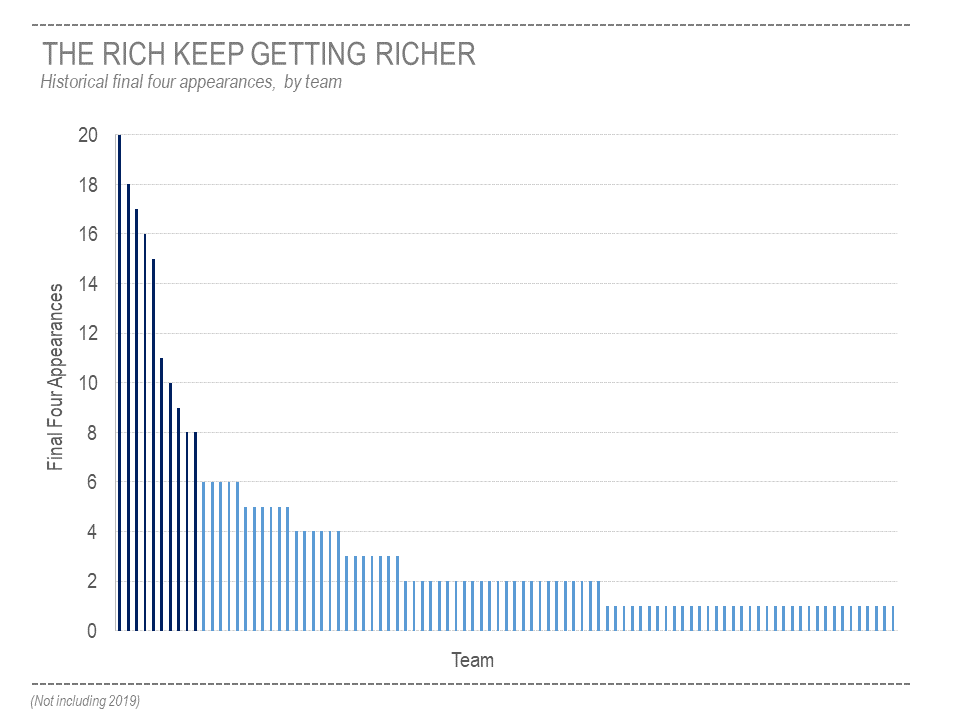
Note the dark blue teams. This represents the top 10 teams by final four appearances. These will be our powerhouses. They account for 132 of 320 final fours, roughly 40%. These teams average 13.2 final for appearances per program. If you had to pick a team to root for, I’d suggest one of these.
Consider the rest of the 83 teams. They have 188 appearances, bringing the average per program to 2.3 final fours.
But this year we have something exciting. Very exciting. Only one powerhouse program made it to the final four – Michigan State.
Consider final four resumes of the remaining field (* indicates championship):
- Michigan State – 1957, 79*, 99, 2000*, 01, 05, 09, 10, 15
- Texas Tech – Never
- Virginia – 1981, 84
- Auburn – Never
How exactly did these perennial winning programs develop? When did they get so strong?
The Emergence of Titans:
I put together a graphic to depict final four appearances throughout the years. The darker the shade of blue, the more success. Note that the third and fourth position are arbitrary.

Hopefully you saw your favorite team on there.
A few recurring names may have popped out at you, the ones in the deep blue colors:

A busy graphic, I know. Let’s break it down team by team –
 Michigan ranks at the bottom of our powerhouses. A lot of final four appearances, but just couldn’t get it done when it comes to championships.
Perhaps the most famous college basketball team of all time, Michigan was home to the Fab Five:
Despite all the hype and talent, they lost in back to back NCAA championship games against Duke in 1992 and UNC in 1993- two other powerhouse teams.
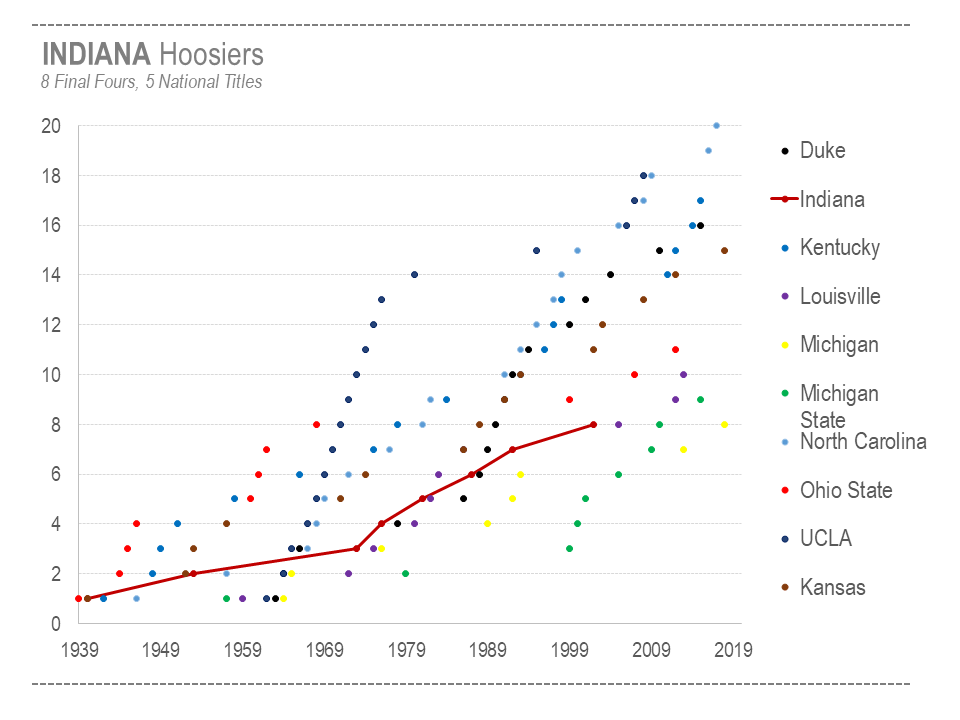 Indiana ranks next as far as final four appearances go, with the same amount as Michigan. A big difference between the two teams however is Indiana’s five championships, ranking them fifth all time for titles. It should be noted however that it has been 17 years since their last final four, the longest drought of any powerhouse team.
To make matters worse, all their previous success is negated when you consider their hideous McDonald’s plastic straw-esque pants:

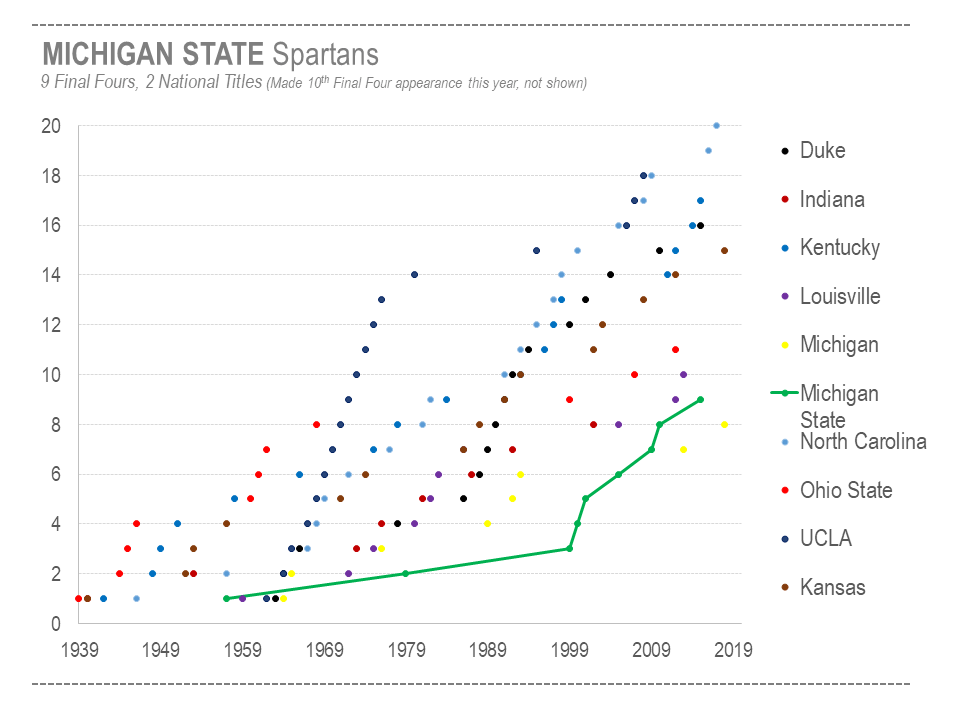 Michigan State had nine Final Four’s coming into the tournament and is now proud to boast of ten. They could be on a run to their third championship.
Consider these amazing accolades from their current head coach, Tom Izzo:
- 22 consecutive NCAA tournament appearances (includes this season)
- Now has led MSU to eight of their 10 Final Four’s
- Won one of their two championships.
- Total record of 606-231, wining 72.4% of all games.
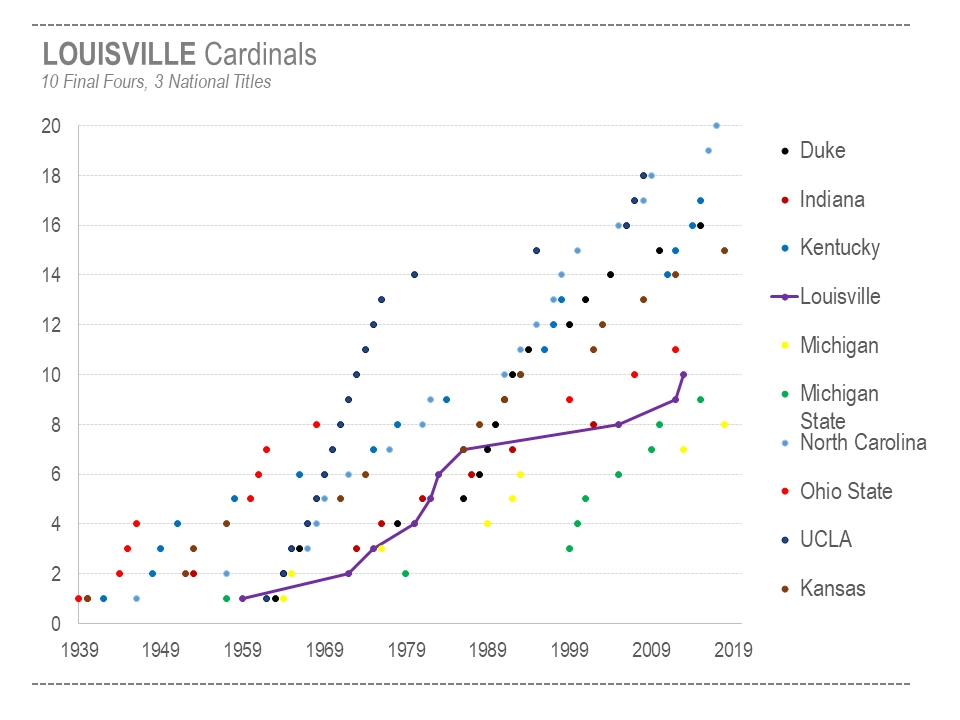 Louisville has 10 Final Fours, three titles, and a whole lot of recent controversy.
Between Rick Pitino’s wrongdoings, Adidas funneling money, and Papa John’s ridiculous bigoted views, Louisville has been doing a lot more damage control than top-notch basketball as of late.
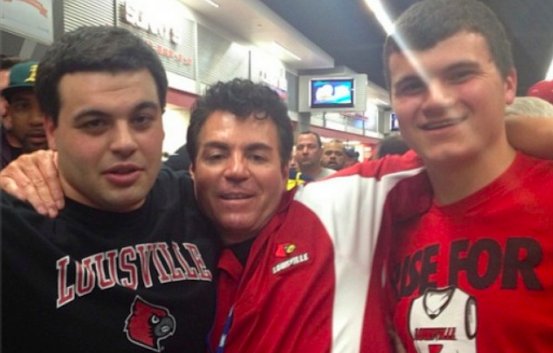
Just a reminder, this is Papa John shitfaced at a Louisville game:
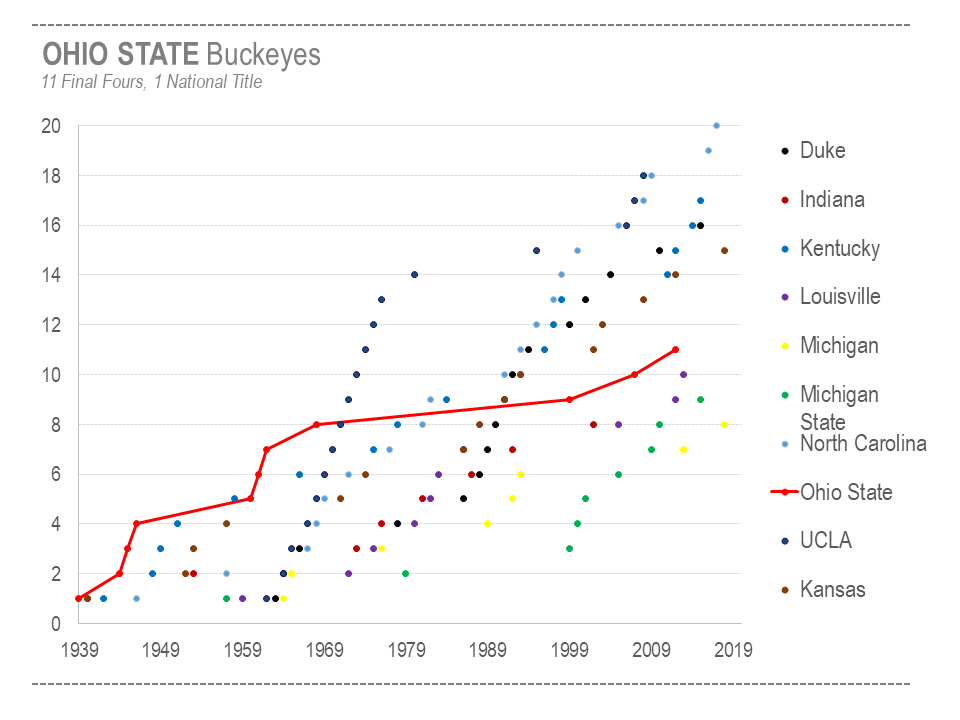 The Buckeyes were busy winning early on, but since 1968 have only had three Final Four appearances.
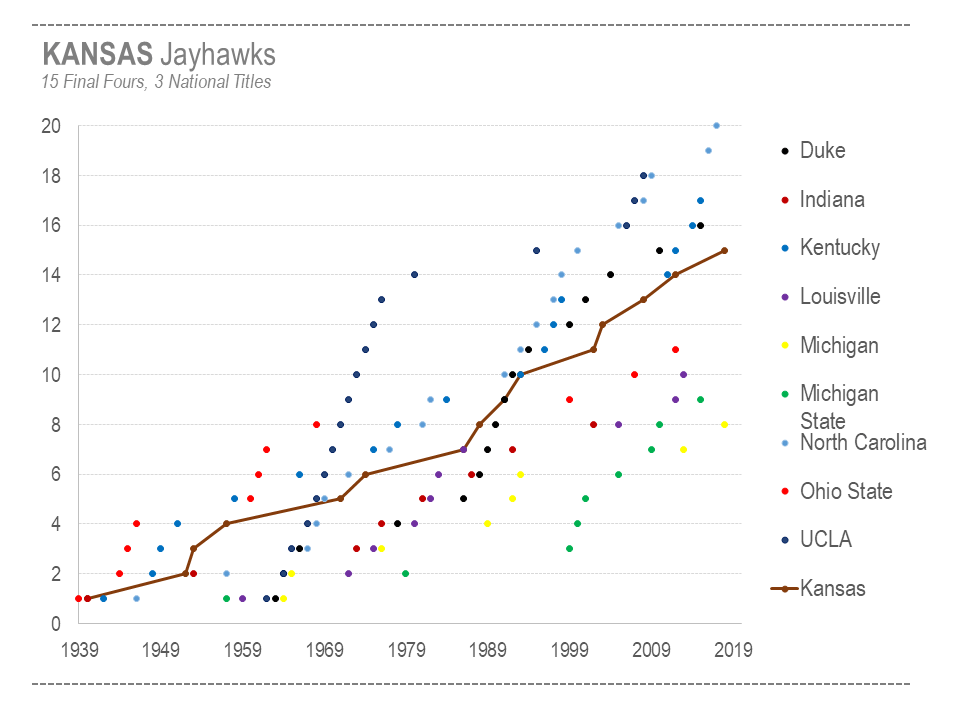 Kansas’ first coach was James Naismith, the inventor of basketball. He actually ended up not being the best coach, but the point stands – Kansas has always been the epicenter of competitive collegiate basketball.
Kansas bred Hall of Fame coaches such as Forrest “Phog” Allen, Adolph Rupp, and Dean Smith. Consider than UNC’s arena is named the Dean Smith Center and Kentucky’s home court is called Rupp Arena. Those guys first played at Kansas.
Kansas holds the longest consecutive NCAA tournament appearances at 30 seasons.
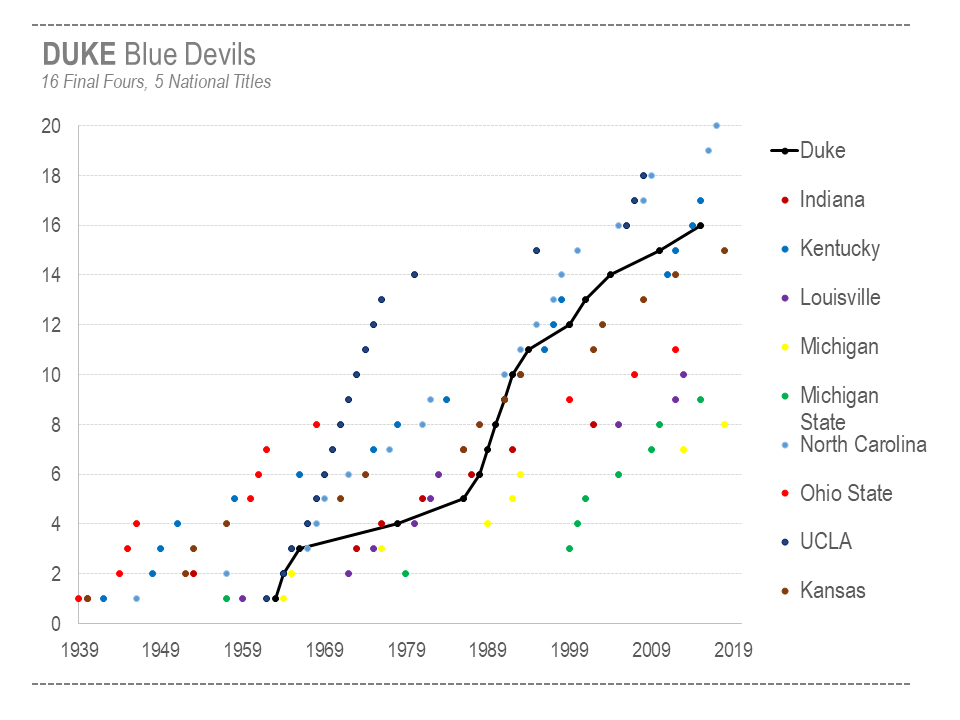 Duke was fairly late to join the party compared to the rest of the powerhouse teams, only securing their first Final Four in 1962. There has been little looking back since.
Mike Krzyzewski (say that five times fast) has been coaching top class basketball for what seems like forever. He has run the Duke program since 1980, in which they’ve made 35 tournament appearances in the last 36 years and 24 consecutively. Coach K has won Duke all five of its national titles and has won the most NCAA tournament games of any coach. He also happens to hold the record for being the winningest coach in college basketball history, male or female.
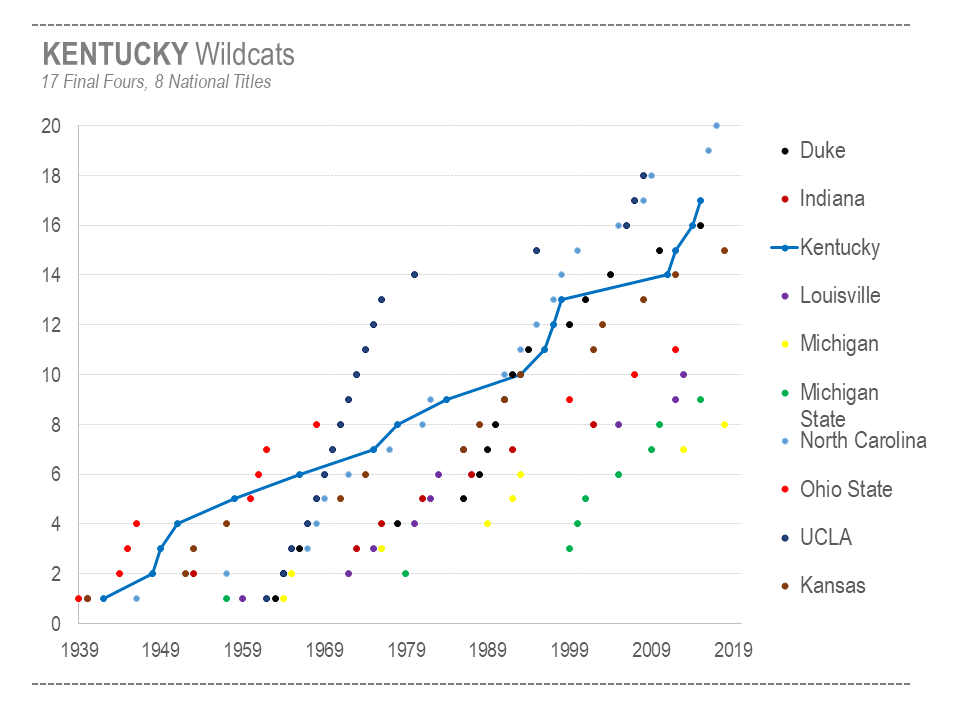 Kentucky wins a lot and has done it with a handful of coaches. They have the most all-time wins in Division I. Not surprising to see a lot of Final Four’s and titles along the way.
They are the only program with five different championship winning coaches:
- Adolph Rupp
- Joe B. Hall
- Eddie Sutton
- Rick Pitino (yes, this guy again)
- John Calipari
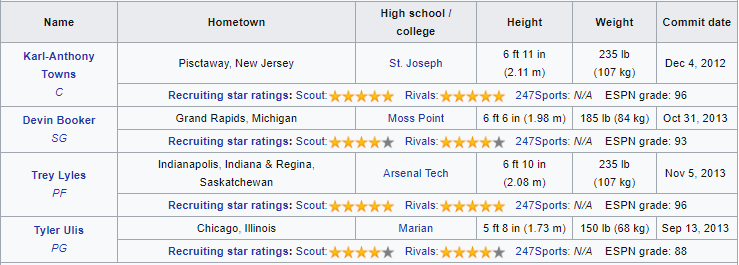
Kentucky is known for some of the most legendary recruiting classes in college basketball, especially in recent years. Different than some of the other powerhouses who recruit strong players to support their existing team, Kentucky has been known to reload in full.
Recognize any NBA stars?
2009:

2010:

2011:
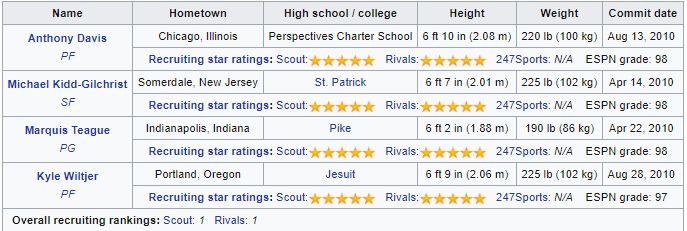
2012:
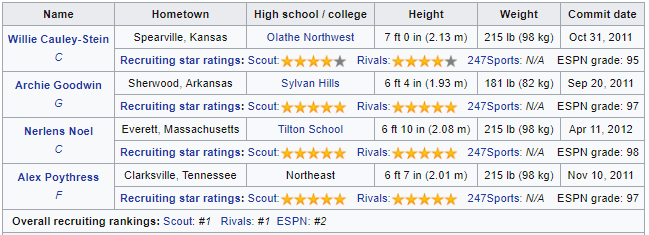
2013:
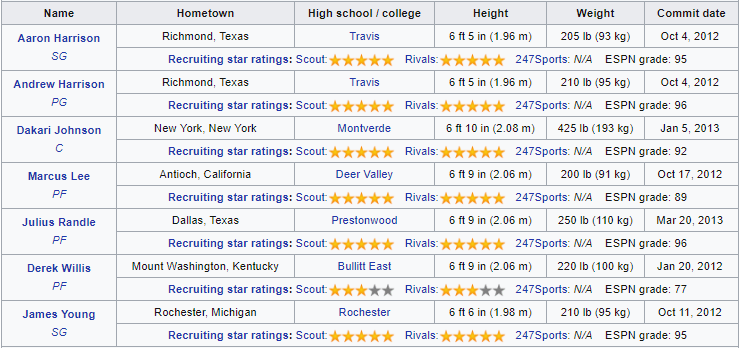
2014:
 John Wooden led UCLA to 10 titles in 12 seasons, seven of which were consecutive. UCLA participated in 13 Final Fours in 14 years. It is nearly impossible to imagine that we will ever see dominance like this again in Division I basketball.
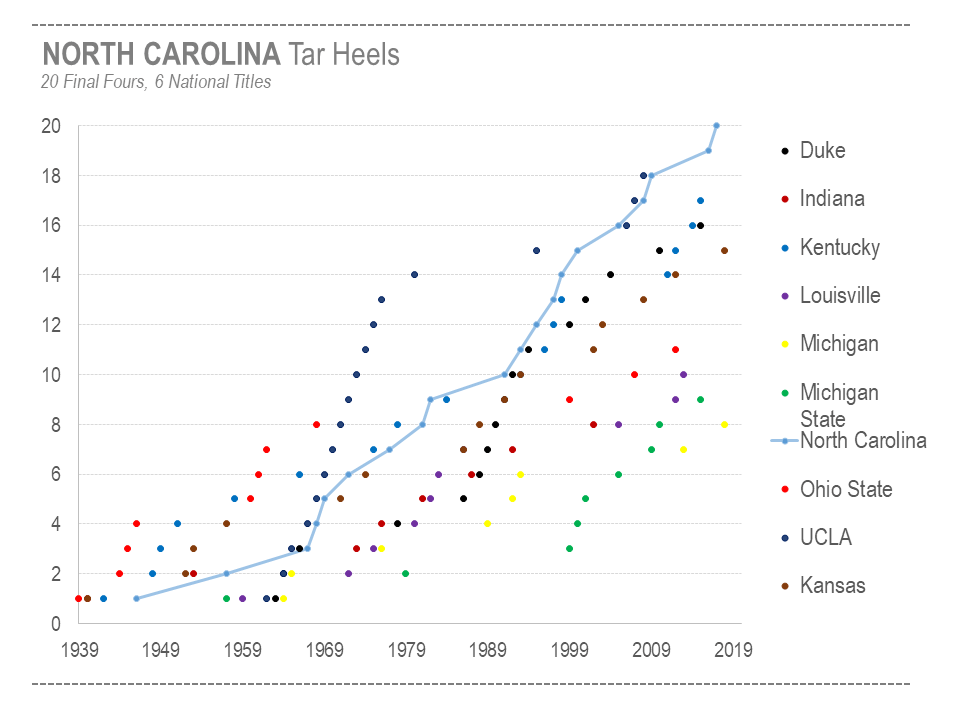 At this point you may be getting bored of me rattling off numbers at you, so I’ll keep it simple. UNC excels and leads the pack in nearly every category possible.
They are the all-time leader of time spent ranked in the Top 25, second highest wining percentage, most consecutive 20-win seasons, and have the highest average wins per season played.
They also have a famous alumni by the name of Michael Jordan. Ever heard of him?
DYNASTIES OF THE FINAL FOUR:
So yes, a handful of teams have dominated when it comes to making the Final Four, but perhaps long term success is not the only way we should evaluate teams. Of course it is impressive to average a new Final Four appearance once or twice a decade and to repeat this feat for over half a century, like most of the powerhouses. But what about the exciting programs that have a few near consecutive years of brilliance? Sometimes the smaller programs put together such a formidable system that they take the college basketball world by storm. Sometimes they can even usurp the powerhouses.
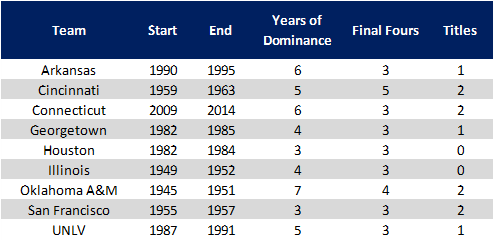
Let’s consider teams that have made the Final Four at least three times in the span of only a few years. If a program can sustain multiple Final Four trips despite graduating players and those leaving for the NBA, there is something really special going on. We shall call them Dynasties.
Using the criteria above, I identified 27 such dynasties. Bad news folks – 18 of them also happen to be powerhouses.
The Powerhouse Dynasties

The Other Guys
BACK TO 2019:
Let’s bring it all back to this upcoming weekend.
Texas Tech, Auburn, and Virginia all are ready to etch their names in the history books. They aren’t powerhouses. They’ve never had a dynasty. The stage is set for something momentous.
In fact, you may hear on TV or the radio just how lucky and stunning it is for Texas Tech (3) and Auburn (5) to have defied the odds to make it this far to the Final Four. “Teams with such low seeds rarely do!” But that of course is a bit of an exaggeration.
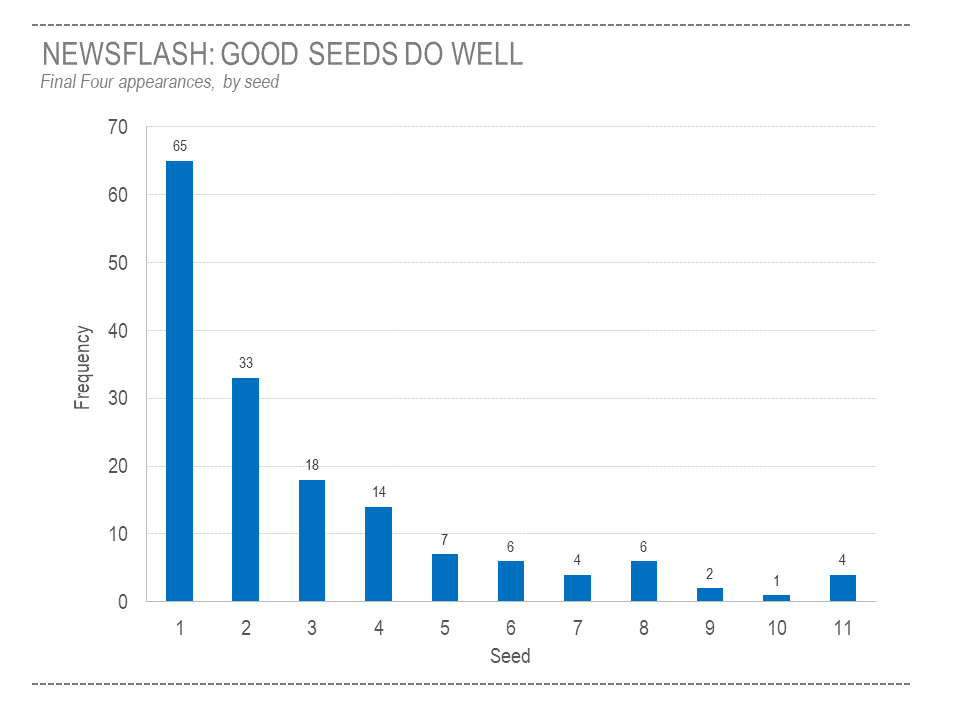
Historically three seeds and five seeds have made it this far in the big dance. If we simplify and assume a team’s chance is directly related to seed, three seeds make it 11.3% of the time and five seeds make it 4.4%. So yes, it is an impressive feat, but the nine seed and beyond is where things really get statistically exciting.
How do their odds fare for wining the title? Not so good:
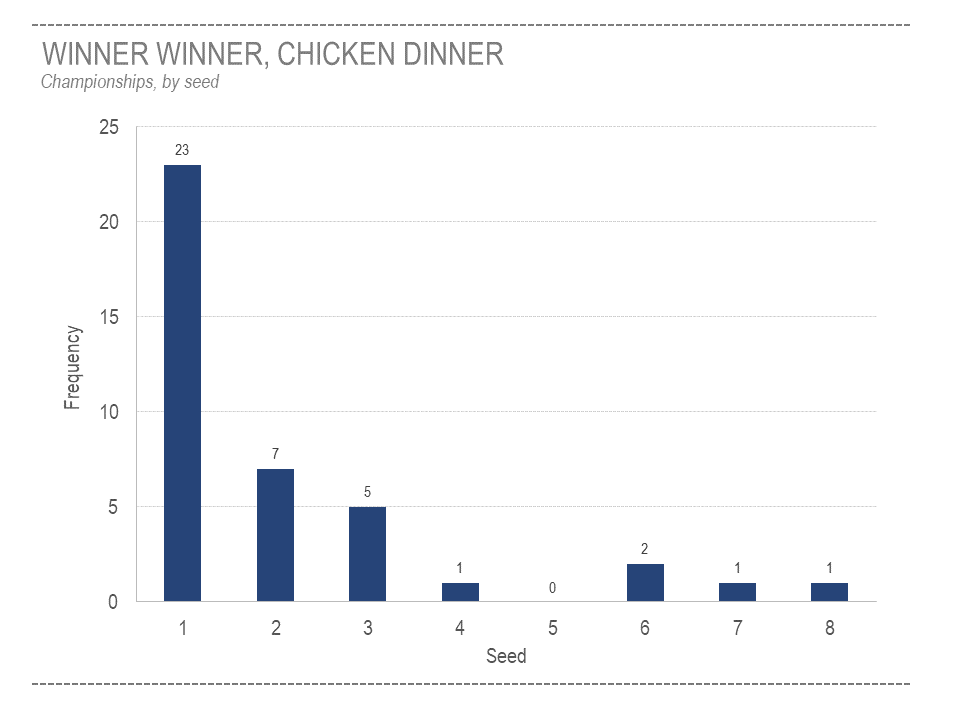 I’m rooting for the little guys this year. I hope you do too.
Thanks for reading,
Peter
 Peter's Secret Blog