
I will start off this post by saying I have never seen the Clifford movie nor remember watching much of the show growing up. All I recall is that for some reason, there is a massively oversized dog, colored bright red, that peacefully roams around and lets children ride on his back. If you love Clifford from your childhood and do not want to hear about how much of a societal inconvenience he would be, then please stop reading now.
Earlier this summer I was having a drunken conversation with a good friend Sam surrounding how unrealistic it would be that Clifford could be so large. We joked about how much he would have to eat on a daily basis and how large his poop must be. Classic stuff really. That’s where it should have ended.
Some time later I thought about it again and wondered if someone on the internet had already explored this. After all, with the correct math it seems doable. What I found appalled me. There were a few estimates, but no one approached this problem correctly! See here and here. I knew I had to step up and do Clifford justice. And write a blog post about it.
I’ve organized this post into three parts as I understand not everyone wants to read a full post on math.
- Part 1 will be the results.
- Part 2 how I know other methodologies were wrong.
- Part 3 my actual process and work.
1. The Stats – Clifford the Big Red Myth
First we need to agree on size. Interestingly enough, there is no one set size for Clifford. He varies based on depiction. In the 2021 live action movie he is no more than 10 feet tall so that he could fit inside a brownstone. Yet in the cartoons he towers over houses, easily topping out at 25 feet tall.
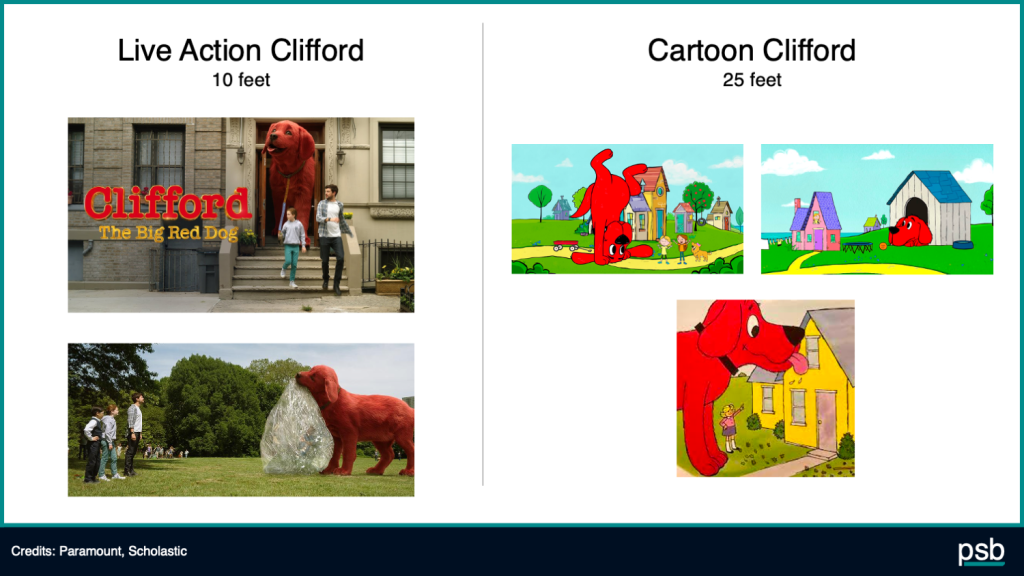
Since we want this post to be as ridiculous as possible, we are ignoring 10 foot Clifford and will be using 25 feet as his height off the ground. That is in a standard four legged position, the top of his head will be 25 feet from the ground. Full length from tail to head would be longer.
Given a 25 foot tall Clifford:
He would weigh around 67,000 lbs. That would be more than five African elephants! It also would be over five T-Rex’s, as they were believed to weigh roughly the same as an African elephant (13,000 lbs).
He would require 260,000 calories per day. That is a lot. That would be equivalent to 6.25 bags of dog food every day, which is about 180 lbs of kibble. Dogs are carnivores, so perhaps feeding him whole animals would be easier? Not a chance. It would require 8.25 goats per day or about half a cow. If you were to force Clifford to be a vegetarian and eat just corn, one would need 5600 square feet of land dedicated to corn just to feed him in a single day. Compare that to the square footage of your house or apartment. Perhaps to make this more easy to visualize, this would be a square of 75 feet on each side.
Clifford must be thirsty as well. He needs 68 gallons of water daily, or 85% of a standard bathtub. One could also measure this as almost 14 Home Depot buckets.
All of this food must leave his body, bringing us to his poop calculation. I audibly laughed out loud as I reached my conclusion: 660 lbs of shit a day.
There are some obvious problems to this math. We’ve assumed that his bone density remains the same, how could his hulking frame possibly hold up this weight? And I don’t even know where to begin calculating if his internal organs would function at this size, but my hunch is absolutely not. Also in general there is a pattern that larger and heavier dogs live shorter than their smaller counterparts. How many dog years does Clifford progress per single human day? This is all sad math I would prefer not to do.
In summary, Clifford is a myth. He was dreamt up by a cartoonist, exploiting the innocence of children. Is it really a coincidence that Clifford was targeted for young kids who had yet to take proper pre-algebra and geometry classes? I think not. There is no Santa Claus. There is no Tooth Fairy. And there surely is no Clifford the Big Red Dog.
Thanks for reading,
Peter
2. Has no one heard of nonlinear relationships?
Ok now that all the non math people left, let’s get into it shall we?
In nearly all other attempts at this I have read, people commit the same mistake: they assume Clifford scales linearly. So if a standard dog is 3 feet tall, and Clifford is 15 feet, they just claim everything is 5x. Five times the weight! Obviously he eats five times more! Why surely, five times as much poop!
But this makes no sense. Consider what happens to a human as we compare sizes. Let’s evaluate two men – shorty (a textbook average five feet tall) and tall guy (a textbook average six feet tall). Tall guy is 20% taller than shorty. So vertically there is a 20% difference. But what about horizontally? Aren’t tall guy’s shoulders wider? And consider his torso, surely it may be a bit thicker? We have changed not just one dimension, but three! You cannot extrapolate linearly unless tall guy is 20% taller, yet the exact same width, and exact same thickness as shorty. We are playing a volume game.
Two scenarios to make this clear. We will default to 10 “units” to be illustrative.
A) Tall guy is 20% taller, but the same in all other dimensions.
Shorty’s volume is: 10 units tall x 10 units wide x 10 units thick = 1000 units of volume.
Tall guy’s is 12 units tall x 10 units wide x 10 units thick = 1200 units of volume.
This is what all others have assumed.
B) Tall guy is 20% taller, but in doing so he is also 20% wider and 20% thicker.
Shorty’s volume is still 1000.
But tall guy is now: 12 units tall x 12 units wide x 12 units thick = 1728 units of volume.
A 20% increase in each direction results in a volume that is 1.7x as large, not 1.2x! Now we are getting somewhere. And given a stable density (weight/volume ratio) we know that weight too must behave in non-linear pattern. For example, if we know humans have a stable 10 units of weight per unit of volume, this applies to both shorty and tall guy! Shorty is 1000 units of volume x 10 units of weight/volume = 10,000 units of weight. Tall guy is 1728 units of volume x 10 units of weight/volume = 17,280 units of weight. Still 1.7x as large! We can confidently say that weight therefore must follow the same scaling behavior.
However, humans are not rectangular prisms! The dimensions as we have described here assumes shorty and tall guy have no curves or appendages. In reality an average six foot man is not going to weigh 70% more than an average five foot man. But the pattern should be clear – whatever we change in height, we are going to expect a larger change in weight. This is what others have missed.
Let’s test our thought experiment with real data to prove the premise. According to standard height and weight charts, an average five foot man should weight between 90-110lbs. Let’s take the average of this range: 100lbs. A six foot man should weight 144-176lb, or an average 160lbs. We see here that 160/100 = 1.6x difference, yet height difference was only 1.2x. Excellent news!
So it should now be clear that we cannot simply throw a linear multiplier on Clifford to determine his volume and weight. But how do we approximate the volume of a dog (who is not a rectangular prism) and then figure out how to scale this appropriately? This is what I solved for.
3. An elegant approach to sizing an outlandishly large canine
I decided that one could model the volume of a dog with eight cylinders. If added up, they would roughly account for the total volume of a dog. There are some areas with double counting (particularly the neck) but then areas like the stomach and top of shoulders that are being missed. All together it is close enough for an approximation. See this diagram:

I have assumed Clifford is most similar to a Labrador Retriever (he kinda looks like one in the live action pictures) and so will be using their dimensions and build moving forward. I found some good graphics online, as well as a sizing chart for a dog jacket. In doing so I was able to create an array of ratios all stemming from a dog’s total height (highlighted in blue for emphasis).
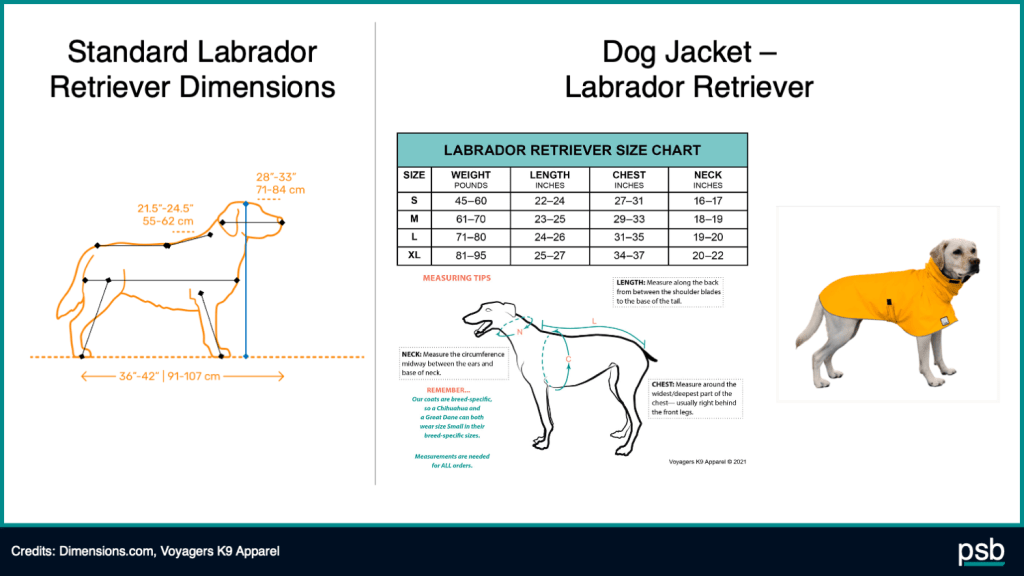
Using the length of the dogs back, I was able to combine both the standard dimensions and jacket chart. This allowed for estimation of the circumferences of the neck and chest as well as weight. Now we were in business! Think of this entire exercise as if I was trying to build a very large statue of a dog. I want to make sure all the various dimensions stay in the correct ratios as we scale this dog up.
I built out a model for both a theoretical medium and large sized Labrador Retriever to see their volume and weight difference. The medium dog was 28 inches tall, 60lbs and I estimate a volume of ~2300 in3. The large dog was 32 inches all, weighed 80lbs and was estimated at ~3800 in3. The densities (lb/in3) of the two dogs were close but not exact, so I averaged the two and assumed that as the stable density for the model moving forward.
And with that, I had a way to estimate weight given height of the dog. To double check that I was heading in the right direction, and to slam dunk on the poorly done efforts by others, I tested my model on various heights. I then wanted to compare to the shape of similar data for humans. Lo and behold, they look nice and similar!
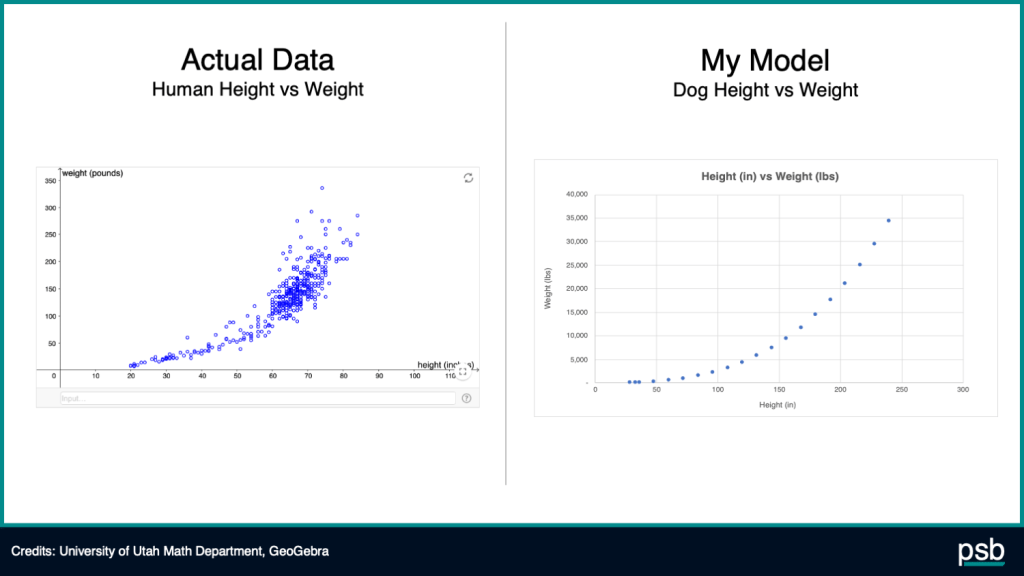
And so, with a 25 foot tall Clifford, we get a final estimated weight of ~67,000 lbs. Thats one hell of a good boy.
With weight it was easy to then move forward on food, water, and poop. I used a veterinary calculator to calculate Resting Energy Requirement (RER) and Maintenance Energy Requirement (MER), which gives the calories per day an animal needs to consume. I found the underlying math behind the estimations from the Ohio State University Veterinary Medical Center to make sure it was not a simple linear application. Fortunately it was not and had proper medical merit, although I am sure no vet would actually advise using such a formula for a dog that weighs as much as five elephants.
There are adjustments one applies to the RER based on a body condition score (scored 1 – 9) and if the dog is neutered. I chose to put Clifford in strong and ideal condition and assumed he was neutered. I would prefer not to think about how big his balls would be if he still had them. All together this generates an estimate that Clifford needs about ~260,000 kcal per day and ~68 gallons of water.
Now knowing his food and drink needs, we can just look at caloric density of different foods to figure out how much he needs to eat. This was actually very informative to compare the nutritional value of different foods – goat meat (651 cals/lb), chicken (1085 cals/lb), 80% lean beef (1152 cals/lb), standard dry dog food (1376 cals/lb), and ground beef (1506 cals/lb). I was unaware dog food was so dense. Also did you know an average cow has an estimated 550,000 calories?
And now everyone’s favorite part, the poop. This actually was a bit unsatisfactory. There are not good charts or guidelines on weight of dog feces. There are countless articles talking about how to look at it and visually gauge health or how many times a dog should go per day, but no one seems to be taking the time to weigh it and then compare to the weight of their dog. Strange. The best I could find was a an estimate from the state of Indiana that dogs poop about 400 lbs a year, or 0.75 lbs a day. I saw some estimates elsewhere by the University of Washington in the 0.5 – 0.75 lb per day range, so we will assume 0.75lbs is for a dog on the larger end. Using our model to find a representative “large” dog, we settle on ~76 lbs. We can then come up with a ratio of poop-to-weight of dog, and apply to Clifford. This definitely could be greatly improved, but I don’t see enough data to build a better approximation and you can sure as hell bet I am not about to go collect data samples myself.
In all, this was quite fun and I was chuckling to myself the entire way. I even worked on this in a public place at one point and know that anyone who saw me drawing dimensional lines on dogs must have enjoyed the show.
Thanks again for reading,
Peter
 Peter's Secret Blog
Thanks for approaching the age old question of how outlandishly large this canine is so elegantly
LikeLike
Incredible post. I enjoyed going through it and running some of the calculations myself. Findings below:
-To be fair, the Nottingham Trent mathematician doesn’t just do 5x poop, he multiplies all dimensions of the poop by 5.445 to get the clifford-sized poop.
-Also, according to the dog-poop calculator the author used, a 76 lb dog would poop 1.14 lbs per day which is a pretty significant increase to the 0.75 lbs you used.
-Still, the final poop weight calculation is REALLY hard to make because it is basically impossible to find data about poop density. I’m sure I waded through the same articles and papers as you did only to decide that the available information is as scant as it is inconsistent.
I’m not sure I ever expected to seriously read so many dogshit articles about dog shit. Thanks for the distraction. I will go delete my search history now.
LikeLike
This blog is tremendous, just like Clifford.
LikeLike